
 By vmg@gmail.com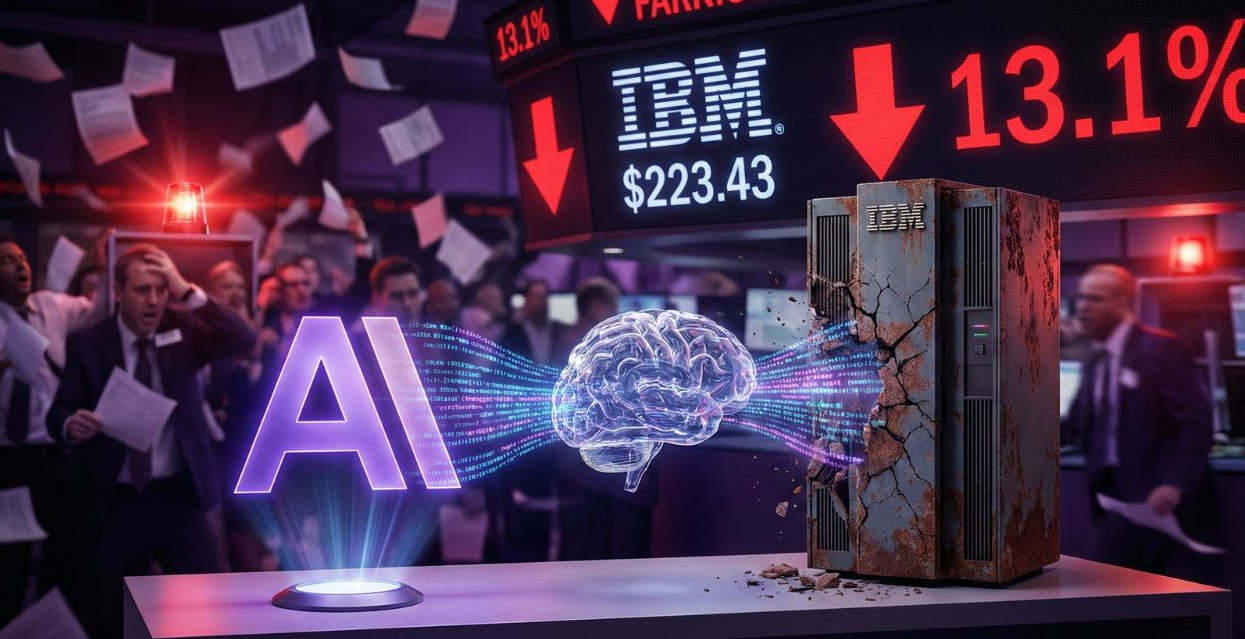
In a dramatic market reaction on Monday, International Business Machines Corporation (IBM) shares plunged nearly 13.2%, closing at $223.35, after AI startup Anthropic announced a major breakthrough targeting one of IBM’s core legacy business strengths — COBOL modernization.
The sell-off deepened investor concerns that generative AI tools are rapidly disrupting traditional enterprise technology models. With Monday’s fall, IBM stock is now down more than 24% year-to-date, intensifying fears that AI-native companies are moving faster than legacy tech giants.
📉 Why Did IBM Stock Fall?
Anthropic revealed that its AI tool Claude Code can automate the complex exploration and analysis required to modernize legacy systems written in COBOL — a programming language that IBM has long supported through its mainframe ecosystem.
COBOL (Common Business-Oriented Language), developed in the late 1950s, remains deeply embedded in:
- 🏦 Banking systems
- 🏧 ATM networks (estimated 95% of U.S. ATM transactions use COBOL)
- ✈️ Airline reservation systems
- 🏛 Government data systems
- 🛒 Retail transaction processing
IBM has historically generated substantial revenue from helping enterprises maintain and modernize these systems.
Anthropic claims its AI can:
- Map dependencies across thousands of COBOL code lines
- Automatically document workflows
- Identify modernization risks
- Reduce months of human analysis into hours
This directly challenges IBM’s high-margin consulting and modernization services.
🤖 What Is Claude Code and Why Is It a Threat?
Claude Code is an AI-powered coding assistant designed to:
- Analyze large legacy codebases
- Detect vulnerabilities
- Suggest modernization pathways
- Reduce technical debt
According to Anthropic, AI flips the cost equation:
“Understanding legacy code used to cost more than rewriting it. AI changes that.”
That statement rattled investors because IBM’s enterprise strategy heavily relies on legacy infrastructure transformation and consulting services.
📊 Market Impact Snapshot
| Metric | Data |
|---|---|
| Closing Price | $223.35 |
| One-Day Drop | -13.2% |
| Year-to-Date Performance | -24% |
| Business Area at Risk | COBOL modernization |
| Competitor Trigger | Anthropic’s Claude Code |
💡 Why Investors Are Nervous
This isn’t just about IBM. The broader market is reacting to AI’s accelerating ability to:
- Replace traditional IT consulting work
- Automate security audits
- Reduce dependency on legacy system specialists
- Compress enterprise transformation timelines
Just days earlier, cybersecurity stocks also tumbled after Anthropic introduced Claude Code Security, a feature designed to scan large codebases for vulnerabilities.
The message from Wall Street is clear:
AI is no longer experimental — it’s attacking core enterprise revenue streams.
🏢 IBM’s Core Challenge
IBM’s mainframe business remains critical for large-scale transaction processing. However:
- Fewer engineers specialize in COBOL
- Enterprises want cost-efficient modernization
- AI tools are making code analysis scalable
If AI tools significantly reduce modernization costs, IBM’s pricing power in consulting and transformation services could weaken.
🔍 What Happens Next?
Investors will watch for:
- IBM’s response strategy
- AI integration into IBM’s own tools
- Earnings guidance adjustments
- Enterprise client retention
IBM has been investing in AI and hybrid cloud solutions, but markets are questioning whether it can defend its legacy moat against AI-native competitors.
🧠 Big Picture: AI vs Legacy Tech
This episode reflects a broader shift:
| Traditional Model | AI-Driven Model |
|---|---|
| Manual code review | Automated AI mapping |
| High consulting cost | AI-assisted modernization |
| Long transformation cycles | Rapid deployment |
| Human expertise scarcity | AI scalability |
The fear is not that COBOL disappears overnight — but that modernization becomes cheaper and less dependent on IBM.
📌 Final Thoughts
IBM’s 13% plunge signals how sensitive markets are to AI disruption narratives. While COBOL modernization won’t vanish instantly, AI tools like Claude Code are challenging the economics of legacy system management.
For now, the market has adopted a “sell first, ask questions later” approach.
The bigger question remains:
Will IBM adapt fast enough to compete in an AI-first enterprise world?