
 By vmg@gmail.com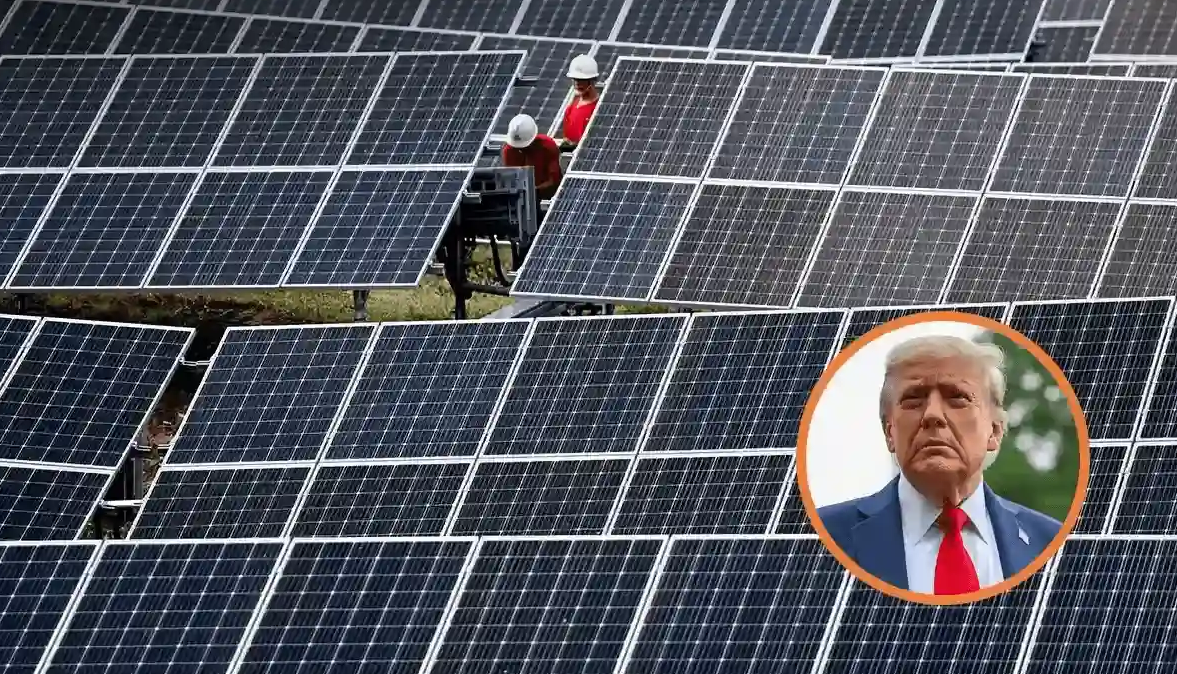
In a move that could significantly strain economic ties between Washington and New Delhi, Donald Trump has imposed preliminary duties of 126% on solar imports from India, citing unfair government subsidies.
The decision, announced by the United States Department of Commerce, raises serious questions about the future of the proposed India-US trade agreement.
India’s solar exports to the US reached $792.6 million in 2024, marking a nine-fold jump compared to 2022 levels — a surge now at risk.
⚖️ Why Did the US Impose the Tariffs?
The Commerce Department determined that Indian solar manufacturers benefited from unfair subsidies that allowed them to undercut American producers.
Preliminary Tariff Rates Announced:
| Country | Tariff Rate |
|---|---|
| India | 126% |
| Indonesia | 86% – 143% |
| Laos | 81% |
The move is part of Washington’s broader protectionist strategy under the “America First” framework.
🤝 What Happens to the India-US Trade Deal?
The tariffs come just weeks after India and the US agreed on a framework aimed at reducing tariffs on Indian exports from 50% to 18%.
However:
- The US Supreme Court had earlier struck down Trump-era tariffs.
- The administration then introduced a new 10% baseline duty on imports.
- Now, the 126% solar tariff signals a renewed hardline stance.
Indian and American officials have already postponed scheduled trade discussions this week — indicating rising tensions.
🔆 The Solar Supply Chain Shift
The surge in imports from India, Indonesia, and Laos accounted for 57% of US solar module imports in the first half of 2025.
This shift is widely seen as Chinese manufacturers rerouting production through Southeast Asia and India to bypass earlier US restrictions.
India emerged as a key beneficiary of this realignment.
📉 Impact on Indian Solar Companies
As of January 2026:
- India’s solar module manufacturing capacity: 160 GW
- Domestic demand: 40–45 GW
With the US being the dominant export market, the new tariffs could result in:
- Excess domestic supply
- Falling module prices
- Pressure on company margins
- Stock market volatility
Industry experts warn of a “dual dilemma” for manufacturers — excess capacity and shrinking export access.
🇺🇸 Headwinds for US Solar Industry
Ironically, American solar firms may also face consequences.
By restricting Indian imports:
- Project costs could rise
- Solar installations may slow
- Inflationary pressure on clean energy projects could increase
- Energy transition timelines may be impacted
The industry is already grappling with high interest rates and supply chain instability.
🗓️ What’s Next?
A final determination on the subsidy investigation is expected by July 6, 2026, alongside an anti-dumping probe.
Until then:
- Trade talks remain uncertain
- Solar stocks may remain volatile
- Diplomatic negotiations could intensify
📊 Key Figures at a Glance
| Indicator | Data |
|---|---|
| India Solar Exports to US (2024) | $792.6 million |
| Increase Since 2022 | 9x Growth |
| India Manufacturing Capacity | 160 GW |
| Domestic Demand | 40–45 GW |
| Final US Decision Expected | July 6, 2026 |
🧭 Bigger Picture
This development underscores a difficult balancing act:
- Strategic partnership between India and the US
- Domestic political priorities in the US
- Global renewable energy transition
- China’s evolving supply chain strategies
For now, “America First” appears to outweigh trade diplomacy.